LONDON — To the untrained eye, a carton of white liquid labeled "milk" should perform much like any other. Whether poured from a glass bottle of dairy or a Tetra Pak of plant-based alternative, the expectation at the breakfast table remains stubbornly consistent: it should whiten coffee, taste pleasant, and, above all, whip up into a rich, velvety microfoam capable of crowning a morning cappuccino.
Yet, anyone who has attempted to steam standard supermarket oat, soy, or almond milk knows the reality is far more humbling. Rather than the glossy, stable peaks achieved with traditional cow’s milk, standard plant-based alternatives often yield a watery hiss, a sparse collection of fragile bubbles, or no foam at all.
This culinary friction is more than a minor annoyance for home baristas—it is a textbook case study in the complex challenges of modern food product development. When substituting a foundational ingredient, the physical and chemical properties rarely match up 1:1. However, as recent food science explorations demonstrate, understanding the "why" behind an ingredient’s failure is the first step toward engineering a successful workaround.
Main Facts: The Physics and Chemistry of the Pour
At the heart of the cappuccino foam dilemma lies a fundamental biochemical divergence. Traditional cow’s milk is naturally engineered for aeration. When heated and whipped, whey and casein proteins unravel, migrating to the air-water interface to trap and stabilize air bubbles. Moderate fat content assists in this delicate equilibrium, though excessive fat can destabilize the structure.
Plant-based beverages, derived from grains, legumes, or nuts, lack this native dairy architecture.
- Oats, almonds, and rice do not inherently possess the protein profiles required to build and hold a resilient foam.
- Soy is an exception, boasting robust plant proteins historically adept at stabilization, yet standard commercial soy milks still require specialized formulation to meet the rigorous demands of commercial coffee equipment.
Recognizing these structural deficiencies, the food industry has spent recent years cracking the code of plant-based foaming. The result is a distinct tier of products lining grocery store shelves: the "Barista Edition." These specialized beverages bridge the gap between traditional dairy performance and plant-based demand, utilizing clever biochemistry, enzyme manipulation, and targeted additive strategies.

Chronology: From Kitchen Counter Failures to Laboratory Breakthroughs
The journey of understanding plant-based foamability follows a classic scientific timeline of trial, failure, analysis, and ultimate reformulation.
Phase 1: The Empirical Test (The 1:1 Replacement)
The initial phase of any ingredient investigation requires empirical action over deep theoretical rumination. When researchers set out to test standard, non-barista cartons of oat, rice, almond, and soy milk in a standard home coffee foamer, the hypothesis was simple: treat them as direct substitutes for cow’s milk.
The results were swift and unambiguous. Standard oat milk failed to produce a functional cappuccino foam, yielding little more than a lukewarm, untextured liquid. Rice and almond milks performed similarly, collapsing almost immediately upon agitation.
In product development, such comprehensive failures are not dead ends; they are vital diagnostic data points. By observing how an ingredient fails—whether it alters taste, color, texture, or structural integrity—developers gain the insights needed to target the root cause.
Phase 2: Diagnostic Deep Dive
Once the initial baseline failure was established, researchers shifted from execution to analysis. Re-examining the manufacturing processes of plant-based milks revealed why standard versions fall short.
While cow’s milk is secreted with its structural components intact, plant-based milks are manufactured by processing raw agricultural materials—soaking, grinding, and sieving almonds or soybeans, or breaking down oats with water. Without deliberate intervention during these processing steps, the resulting beverages lack the viscosity and surface-active proteins necessary to lock air bubbles into place.

Phase 3: The Industrial Pivot to "Barista" Formulations
Recognizing market demand, manufacturers bypassed standard processing to develop dedicated barista lines. When tested under identical conditions, these barista-grade alternatives achieved what their standard counterparts could not, producing rich, stable foams that fundamentally transformed the plant-based coffee experience.
Supporting Data: Dissecting the "Barista" Label
A comparative evaluation of standard versus barista-grade plant-based milks reveals distinct manufacturing strategies tailored to each base ingredient.
1. Oat Milk: Manipulating the Enzymatic Process
Comparing the ingredient declarations of standard and barista oat milks often yields a surprising discovery: the listed ingredients and nutritional profiles are frequently identical.
The breakthrough does not lie in added substances, but in process engineering. The production of oat milk heavily relies on enzymes to break down starches and proteins into manageable fractions. By fine-tuning this enzymatic phase—adjusting reaction times, temperatures, and specific enzyme selections—manufacturers can precisely alter the size and functionality of oat proteins and carbohydrates. This molecular tailoring optimizes their ability to encapsulate and stabilize air bubbles without altering the clean, neutral flavor profile consumers expect from oats.
2. Almond Milk: Engineering Stability Through Additives
Unlike oats, almond milk requires exogenous structural support to achieve foamability. Analyzing a barista-grade almond milk label reveals a supporting cast of functional ingredients absent from the original version:
- Tapioca Starch and Potato Protein: Tapioca starch increases the liquid’s viscosity, making it harder for trapped air bubbles to merge and escape. Potato protein assists in initial foam formation and stabilization.
- Sunflower Oil: Provides mouthfeel and richness, mimicking the creamy texture of dairy fat.
- Dipotassium Phosphate: Acts as a pH buffer, stabilizing the acidity of the beverage to ensure that the added proteins operate at peak structural efficiency. It also serves as an emulsifier to keep the sunflower oil seamlessly integrated into the liquid matrix.
3. Soy Milk: Refining Viscosity and Acidity
Soy represents the closest natural relative to dairy in terms of protein functionality. Barista-grade soy milks frequently introduce subtle modifications, such as the inclusion of apple extract. This addition provides minimal sugars to enhance viscosity and helps stabilize the beverage’s pH value, optimizing the natural foaming capabilities of soy proteins.

Official Responses and Industry Perspectives
Food scientists and product developers emphasize that engineering plant-based functionality is a delicate balancing act between physics, chemistry, and consumer sensory expectations.
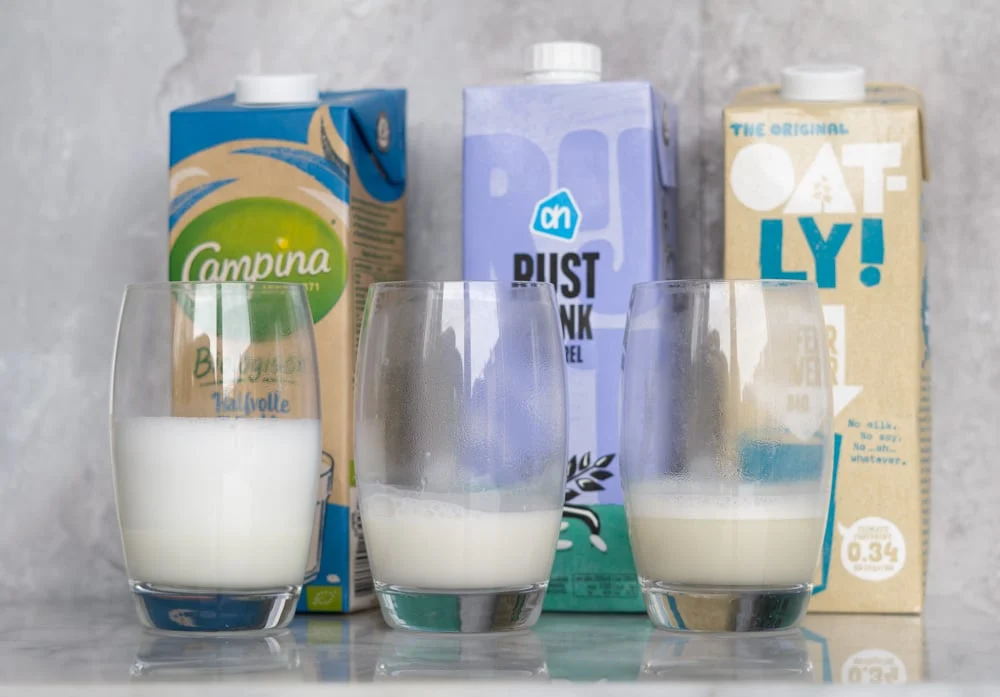
Industry stakeholders note that consumer evaluation extends far beyond visual aesthetics in a glass. While all three barista alternatives (oat, almond, and soy) successfully generated foam during testing, their sensory and physical behaviors diverged wildly:
- Almond Foam: Exhibited the firmest structure and highest stability, though it required a complex matrix of starches and proteins to get there.
- Oat Foam: Proved to be the least stable of the evaluated trio, displaying fragile bubbles that rapidly increased in size upon stirring—a classic indicator of structural degradation.
- Soy Foam: Settled into a middle ground, producing a light and fluffy texture, though taste evaluations revealed a distinct beany aftertaste that polarized testers compared to the more neutral profiles of oat and almond.
Implications: The Future of Functional Plant-Based Foods
The evolution of plant-based barista milks carries profound implications for the broader food and beverage sector. It underscores a vital lesson for product developers across all categories: ingredient functionality is rarely inherent when transitioning from animal to plant-based systems; it must be intentionally engineered.
As consumer demand for sustainable, plant-forward alternatives continues to accelerate, the pressure on food scientists to manipulate texture, mouthfeel, and thermal stability will only intensify. The success of the barista milk category proves that with precise enzymatic control, targeted hydrocolloids, and careful pH management, the gap between alternative and conventional foods can be successfully bridged—one microfoam cappuccino at a time.