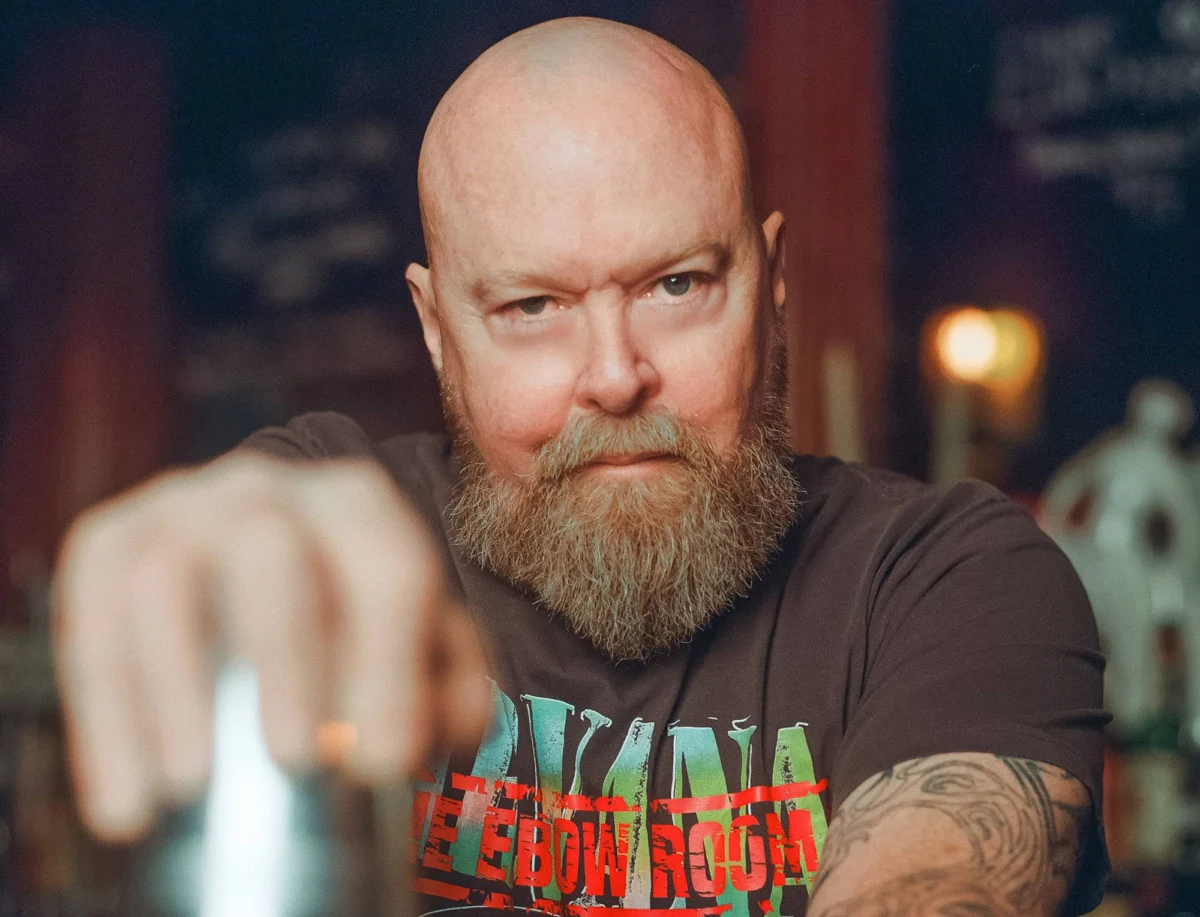
For over three decades, Toby Maloney has been a towering figure in the American cocktail renaissance. Having logged an estimated 60,000 hours behind the stick—far exceeding the legendary 10,000-hour mastery threshold—Maloney’s influence is etched into the DNA of modern mixology. Best known for his tenure at the influential Chicago bar The Violet Hour, Maloney has spent his career not just mixing drinks, but deconstructing the very essence of what makes a liquid experience memorable.
In his latest work, The Classic Cocktail Sessions, published this past June and co-authored with Emma Janzen, Maloney pivots away from the rote memorization of recipes. Instead, he advocates for a radical shift in perspective: prioritizing technique and intent over the rigid adherence to measurements. As we discuss in our July/August 2026 issue, this philosophy is the natural evolution of his James Beard Award–winning debut, The Bartender’s Manifesto. For the home bartender and the seasoned professional alike, Maloney’s message is clear: stop chasing recipes and start understanding the physics of flavor.
The Hierarchy of the Highball: What Truly Makes a Great Cocktail?
In the professional bartending world, "good enough" is often cited as the greatest enemy of excellence. When Maloney speaks about his craft, he does so with the precision of an engineer. He argues that most enthusiasts fall into a trap by over-indexing on "flavor," which he ranks surprisingly low in his hierarchy of cocktail success.
"I realized that everybody talked about flavor when they talked about cocktails," Maloney reflects. "But I once had a drink that was so poorly constructed—the texture was like razor wire and thumbtacks—that I couldn’t even identify the flavor. It was a lightbulb moment. Texture is the primary anchor of a cocktail, followed closely by temperature, balance, and aroma."
Maloney’s framework is revolutionary because it reorders the sensory experience. By his estimation, if you get the texture and temperature right, the flavor follows as a natural byproduct. He rounds out his list with a fifth, more abstract element: the narrative arc. Together, these pillars form the foundation of his pedagogical approach, which he breaks down into actionable steps for any aspiring bartender.
Texture: The Mouthfeel of Mastery
Texture is often the missing link between a drink that is merely "fine" and one that feels professional. Maloney illustrates this by comparing a well-made cocktail to a carbonated soft drink. "If you’ve ever had a flat Coca-Cola, that illustrates the difference between good and bad texture," he explains.
In his view, bad texture in a cocktail manifests as either an overly sweet, gummy mouthfeel or a "hot," aggressive burn from unintegrated alcohol. Achieving superior texture requires an intimate understanding of your ingredients. For a shaken drink like the Jungle Bird, texture is a confluence of factors: the specific proof of the rum, the viscosity of the pineapple juice, and the aeration achieved during the shake.
"If you use a blackstrap rum versus an 80-proof rum, the weight of the spirit changes how the cocktail moves on the palate," Maloney says. "You have to adjust your technique—your shake time and intensity—to compensate for those variables."
For stirred drinks, such as the Manhattan, the goal is a silk-like viscosity reminiscent of maple syrup. Maloney maintains a strict rule: "Double-strain everything. There are very few reasons to have little bits of ice floating on top of your drink. It’s like sand in your peanut butter and jelly on the beach—it’s just the worst."
Temperature: More Than Just Chilled
Temperature is not merely a matter of serving a cold drink; it is a diagnostic tool for the bartender. Maloney argues that if a cocktail is not hitting the right temperature, it is a glaring signal that the underlying ratios or water content are incorrect.
"You can’t achieve the correct temperature in a drink that isn’t boozy enough," Maloney notes. "You need the alcohol to facilitate a frigorific temperature, allowing the drink to drop below 32 degrees Fahrenheit."
In the context of the Jungle Bird, Maloney utilizes overproof rum to provide the necessary backbone, ensuring the drink remains icy even after it hits the glass. By cooling the glassware beforehand—a simple but often overlooked step—he prevents the "blast of dilution" that occurs when a cold liquid hits a room-temperature vessel.
For spirit-forward drinks, the narrative of temperature is even more critical. As the drink sits, it warms, and as it warms, the volatile aromatics of the whiskey become more apparent. A well-constructed Manhattan is designed to evolve, offering a different profile from the first sip to the last.

The Delicate Act of Balance
Balance is the most nebulous of Maloney’s factors, yet it is the one that ties everything together. It requires a deep knowledge of one’s components before the mixing tin even touches the ice.
"Before I start shaking, I’m thinking about the characteristics of the rum, the specific red bitter being used, or whether the pineapple juice is fresh-pressed or canned," he says. "If a drink feels sharp or burns on the palate, I know I need to adjust my stirring time or slightly increase the dilution. If it feels too thin, I might add a splash of a higher-proof spirit to give it body."
This is where the "tasting as you go" philosophy becomes essential. Maloney encourages bartenders to treat the mixing process as a dialogue with the liquid. Whether adding an extra dash of bitters or a fraction of an ounce of base spirit to brighten a profile, balance is a dynamic, rather than static, state.
Aroma: The Sensory Gateway
Aroma is the customer’s first point of contact with the cocktail. Maloney posits that scent is the most effective way to manipulate the drinker’s perception of flavor—specifically sweetness.
"You can have a drink that is objectively sweet, but if you express a lemon peel over the top, the brightness of those citrus oils tricks the brain into perceiving the drink as less sugary," Maloney explains. "It’s a psychological hack that allows you to maintain the perfect texture while keeping the flavor profile crisp."
In his analysis, garnishes are not merely aesthetic; they are functional. In a Manhattan, the lemon or orange twist acts as an "acidic" foil to the "cooked" flavors of the distilled grains and barrel-aged whiskey. It provides the brightness necessary to cut through the heavy vanilla and clove notes of the spirit.
The Narrative Arc: The Story of the Sip
Perhaps the most compelling addition to Maloney’s methodology is the "narrative arc." He views the cocktail as a story that unfolds from the moment the guest sees the drink pass by on a tray to the final, lingering drop.
"The narrative starts with anticipation," says Maloney. "It includes the glass, the garnish, and the ice. It then moves to the attack—the first sip—followed by the mid-palate development, and finally, the finish."
This concept mirrors the stages of tasting fine wine, but with the added complexity of dilution. Maloney even encourages "plot twists" in the drinking experience, such as transferring a Martini into a fresh, frozen glass halfway through to maintain temperature, or adding a secondary citrus element to a Manhattan to shift its character mid-drink.
Implications for the Future of Mixology
Toby Maloney’s approach suggests a return to the fundamentals, but with a more sophisticated understanding of physics and human perception. By moving away from the "recipe-first" mindset, he is empowering a new generation of bartenders to be creators rather than assemblers.
The implication is a more personalized drinking experience. When a bartender understands how to manipulate texture, temperature, and aroma, they can tailor a drink to a specific guest’s preferences rather than relying on a static menu.
"I wouldn’t call myself a metaphysical person," Maloney concludes. "But I truly believe that the more concentration and energy you put into the intent behind a drink, the better it’s going to be. Intention matters. When you treat the process as a narrative, you aren’t just making a drink; you’re crafting an experience."
As the industry continues to evolve, Maloney’s focus on the "why" and "how" of mixing ensures that the art of the cocktail will remain as much about the intellectual rigor of the maker as it is about the final result in the glass. For those ready to step behind the bar, the Classic Cocktail Sessions are officially in progress.